

Key Takeaways
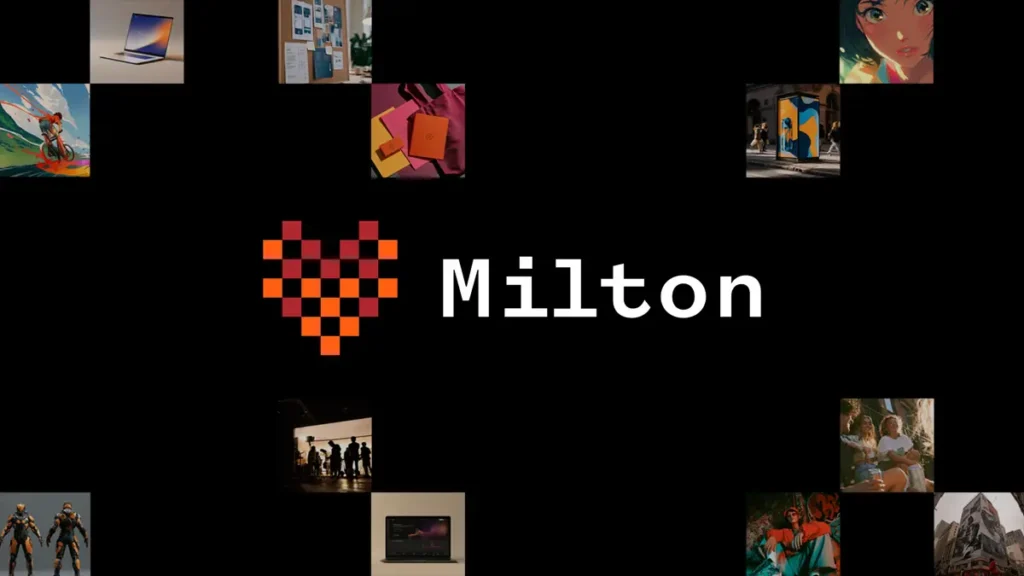
- Milton is Aquent's proprietary AI portfolio search engine, built specifically for creative hiring.
- It searches more than 10 million portfolio images (and growing) by what the work actually looks like, rather than by the words used to describe it.
- Your Recruiter can search from a reference image or a plain description of what you want, which means your shortlist can more closely reflect what you had in mind.
- Personalized talent pools built on Milton are next, giving you an always-on bench of vetted talent for future work.
Every creative hire begins with a picture in your head. Maybe it's a campaign that landed, a brand whose art direction feels close, or work from your own team. You know it when you see it.
But there’s been a blind spot at the center of creative search. Career sites and applicant tracking systems cannot see or search visual assets, so the portfolios sitting inside them stay effectively invisible. What is visible is fragmented across portfolio websites and platforms, with no single place to look. As a result, finding candidates often comes down to reviewing portfolios manually, one sample at a time. That takes time and makes it easier for strong candidates to be overlooked.
The impact shows up quickly in the hiring process. A Recruiter may have a clear brief and a strong understanding of the role, but they are still limited by what can be found through traditional search methods and what there is time to review. Milton was built to address that gap.
Milton sees what keywords miss
Milton was built in-house for a specific purpose: helping Recruiters search creative work more effectively.
Milton's proprietary visual search technology interprets portfolio images and identifies work that aligns with what a client is looking for. It currently draws on more than 10 million portfolio images and counting, allowing Recruiters to surface relevant visual matches in seconds rather than relying only on the language attached to a portfolio.
Your Recruiter can search it two ways. They can describe what they are looking for in ordinary language, using a full sentence rather than trying to anticipate the right combination of keywords. A search can be as plain as: packaging design for canned drinks with bright colors, or product photography for sports apparel with moody lighting. From there, the results can be refined using practical criteria such as location, availability, and rate.
For decades, creative hiring has relied on keyword searches that simply cannot see what is actually in a talent's portfolio.
John H. Chuang Founder and CEO, Aquent
Your Recruiter can also skip words altogether and search with images, so the search runs against the work itself, not a description of it.
That image-based search helps address one of the hardest parts of a creative brief: the things that are easy to recognize visually but difficult to describe precisely. Instead of trying to translate every aspect of a reference into words, you can simply show what you mean.
What changes in the conversation with your Recruiter
The intake call is one of the most important conversations in creative hiring. You describe what you need in a mix of stylistic language, brand references, and role requirements. Your Recruiter then translates that conversation into a search strategy, and that translation is not always straightforward. Candidates can meet the requirements on paper and still not look like what you had in mind, because the gap between a visual idea and the words used to describe it may not become clear until you see the results.
Milton gives the Recruiter another way to close that gap earlier in the process. The usual questions still matter: what are the deliverables, what will this person actually be producing, and what does success look like in the role? But the conversation can now include another useful question: can you show us examples of the kind of work you have in mind?
A reference image is no longer just additional context for the Recruiter. It can become part of the search itself. That gives you and your Recruiter something concrete to align on before the search begins and helps make sure you are picturing the same thing from the outset.
The goal is a stronger first shortlist, with fewer candidates who are technically qualified but visually off the mark. That means less time spent explaining why something is not quite right and more time evaluating the people whose work genuinely fits the brief.
What visual search looks like in practice
Here's one of Milton’s first success stories. A global skincare company needed a Packaging Designer skilled in mechanicals, die-lines, and 3D renderings, as well as the regulatory rules governing small surfaces.
We submitted a fully vetted candidate in one day, and the role was filled in two weeks.
Our talent network is large enough that even highly qualified professionals can be difficult to surface through a traditional search. This candidate had been in our network for years and had previously worked with another beauty client. Milton brought the candidate's work forward based on its visual relevance to the brief, after which the Recruiter confirmed the technical requirements through the resume and portfolio review.
Nothing about the candidate had changed. What changed was our ability to find the right work quickly enough for it to shape the first round of the search.
What's next: Your always-on pool of vetted talent
For years, clients have been asking for a bench of talent that stays current and reflects the kinds of people they hire most often. Maintaining those pools manually is difficult because the underlying talent network is constantly changing. Milton creates the foundation for a more dynamic approach, in which newly added work that matches a client's criteria could surface without requiring someone to rebuild the list by hand.
Some teams want to know the moment a UX Designer with their industry experience appears in their city. Others hire against specific visual criteria, like a certain luxury sensibility or a narrow craft category, where the viable pool is small, so anyone new is worth knowing about right away. For teams working on tight turnarounds, having a current pool of talent that already aligns with rate, location, experience, and visual criteria can make it much easier to start a search from a position of strength.
Aquent has spent 40 years building one of the largest and most specialized networks of creative, design, and marketing talent in the world. Milton gives our Recruiters a new way to search that network, using the creative work itself alongside the information that has always mattered in hiring.
For hiring managers, that means the picture in your head can play a much more direct role in the search, rather than being something your Recruiter has to translate into keywords and hope to re-create.
Want to find creative talent with Milton? Get started here: aquent.com/milton.
About the authors

Michaela Harkins is Director of Product Strategy at Aquent, where she helps shape product strategy across the company’s technology ecosystem. With deep experience in product, technology, and staffing, she focuses on turning complex problems into useful solutions and exploring how AI can improve work while centering people and human creativity.

Kirk is a Principal Product Manager at Aquent with more than 20 years of experience across product, technology, operations, systems, and finance. Throughout his career, he has focused on turning complex business challenges into practical, people-centered solutions that improve how teams work and create measurable value for organizations. Kirk is leading the Product effort for Milton, Aquent’s AI-powered creative talent portfolio search tool. He values curiosity, collaboration, and leading with kindness. Kirk lives in the Boston area with his family.
Latest.

Build your recruiting pipeline before you need it.
Retention Strategies, Talent Acquisition & Recruitment


Is your staffing partner building for the agentic web?
Career Advice, Engineering & Technology, Experience & Product, Innovation & Emerging Tech


Systems thinking is the AI skill nobody is talking about.
Career Advice, Leadership & Management, Engineering & Technology, Innovation & Emerging Tech