
What's Inside
Overview
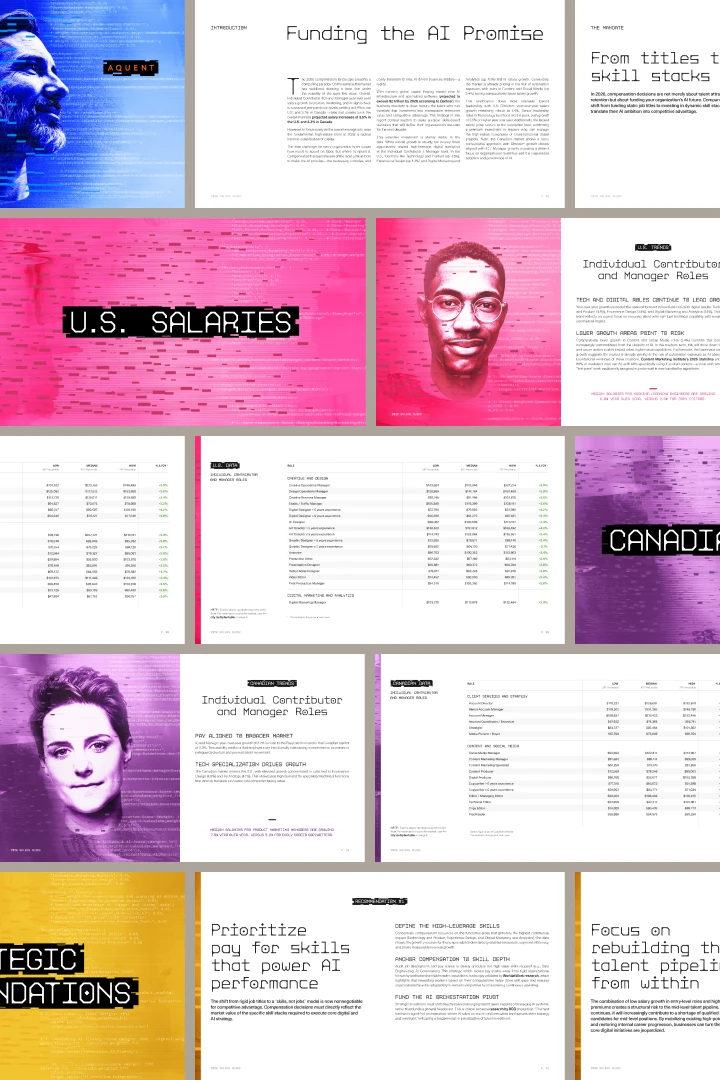
The 2026 Salary Guide delivers up-to-date information on 2026 hiring trends, workplace insights, and the salaries you need to build high-performing teams.
Salaries by Geography
See up-to-date salary benchmarks across the U.S. and Canada, plus city multipliers to pinpoint pay by market.
Senior- and Executive-level Salaries
Benchmark senior- and executive-level salaries by company size and role, and see why senior leadership continues to command a premium.
Salaries for Emerging Roles
See salary data for emerging and in-demand roles, including AI Product Manager, Technical Artist, Creative Technologist, and NLP Engineer.
Strategic Recommendations
Get a clear playbook to prioritize pay for high-leverage skill stacks, strengthen retention, and support internal mobility.
AI changes everything
This year, AI has dominated headlines and changed the hiring landscape, so we’ve highlighted some of the most cutting-edge job functions across the industry with salary data available for these and other emerging AI roles in our guide.

AI Product Manager
The bridge between business needs and technical reality. The AI Product Manager (AI PM) role has evolved from a niche title to one of the most critical leadership positions in tech. AI Product Managers oversee the lifecycle of an AI product, ensuring it actually solves a customer problem.
This role has become one of the most competitive and well-compensated specializations in the technology sector. AI Product Managers are the highest-paid emerging role, with a median base salary of $162,000.
AI Automation Engineer
Automation Engineering is undergoing one of the most significant transformations in the entire tech sector. Gone are the days of strict “if-then” rules to handle repetitive tasks. This role has pivoted toward intelligent automation, where you build systems that can think, adapt, and learn.
As of early 2026, the demand for Automation Engineers in the United States continues to grow, driven by the massive expansion of smart manufacturing, data centers, and AI-integrated systems.

Technical Artist
Technical Artist (TA) roles and responsibilities are rapidly evolving. Technical Artists not only bridge the gap between artists and programmers, they also now work at the intersection of creative intent and generative models.
As gaming and film studios move away from manual execution toward generative workflows, they need TAs to build the infrastructure that makes AI usable for artists. In this setting, they integrate tools like Stable Diffusion, ComfyUI, or proprietary LLMs directly into software like Maya, Houdini, or Unreal Engine.
Synthetic data is the fastest-growing sub-sector for Technical Artists outside of entertainment. These TAs use game engines such as Unreal or Unity to build hyper-realistic 3D environments.